
Guide to car park line marking
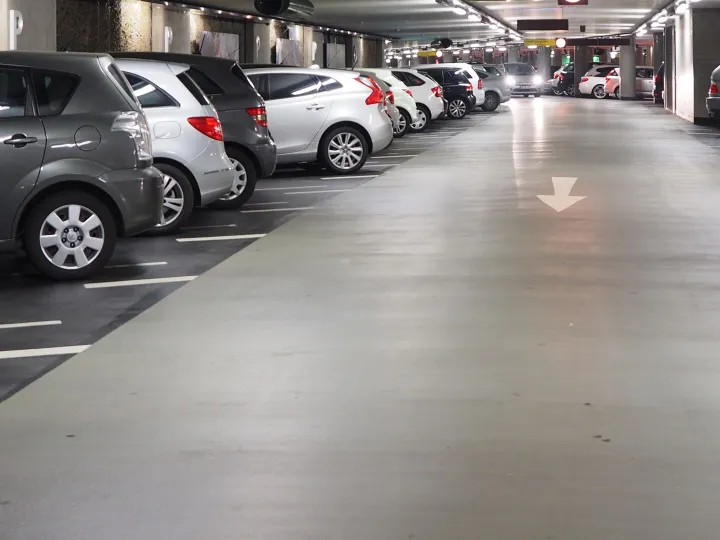
Why paint on tarmac matters
After years on site for MCP, one thing has become obvious to me: most people do not consciously notice car park markings until they are missing. The moment the lines fade, I see the same problems repeat themselves. Drivers start parking haphazardly, pedestrian routes are ignored, traffic jams appear where they shouldn't, and safety risks multiply. Whether we are working on a retail park in Birmingham or an office complex on the edge of London, poor car park line marking almost always leads to frustrated staff and unhappy visitors.
For us, it is never just about order. Markings carry strong visual messages, and I notice how quickly first impressions form. A site with crisp white bays and bold directional arrows feels professional the minute a customer drives in. One with peeling or barely visible lines suggests a lack of attention, even when the building’s interior is immaculate.
In an era when hybrid working has made every office journey a conscious decision, these details have become even more important. I regularly hear facilities managers say they now treat the appointment of a car park painting contractor as a strategic facilities choice rather than just another odd job, and that mirrors what my team and I experience on the ground
The real breakdown of costs
When I am asked, “How much does it cost?”, the honest answer is that it varies, but there are useful benchmarks we in the industry rely on. Thermoplastic line markings, which I often recommend for busy sites, are heated onto the surface and form a bond that typically lasts five to seven years under normal UK conditions. They are usually around twice as expensive as water-based traffic paints, but in my experience, they last significantly longer, so repainting is needed far less often.
By contrast, painted markings using standard compounds may only hold for two winters, particularly in exposed or high-traffic car parks. I have seen small retail forecourts save a few hundred pounds initially, only to pay double over a decade because of repeated repaints.
Labour is another major factor we always build into quotes. Most car park painting contractors, including us, will quote either a flat day rate or per-space pricing. A typical bay might cost between £4 and £7, while specialist logos such as electric vehicle charging points or wheelchair symbols usually cost £15–£20 each due to the need for stencils and colour coding.
Contractors often add a base charge, typically £250 to £500 per day, to cover travel and equipment. On the large sites we work on, this can bring the total into the thousands, which is why I always recommend an itemised quote so clients can clearly see where the hours and materials are going.
Regional and seasonal economics
One factor many businesses underestimate, but I encounter regularly, is how geography influences price. In London and the South East, costs are routinely 15–20 per cent higher than in other regions due to higher labour rates and strong demand. When working in cities such as Manchester, Newcastle or Glasgow, the same-size job often comes in cheaper. Rural areas present a different picture again. If your car park is in the middle of North Yorkshire or deep Devon, you should expect quotes that include travel or even accommodation for crews who cannot reasonably commute back the same day.
Seasonality also plays a big role in planning. Every year, we see demand spike in summer, as firms prefer to repaint during favourable weather, which leads to packed diaries and higher day rates. If you book in May for July, you may find availability limited unless you are prepared to pay a premium. Winter can be cheaper, but I have learned the hard way that damp or freezing surfaces are much harder to work on. In those conditions, specialised primers may be required, or we may need to spread work over several days. The most organised facilities managers I work with commission car park line marking in spring or autumn, avoiding both weather extremes and peak-season premiums.
The importance of compliance
From our perspective, painting bays is never just about aesthetics. A good car park painting contractor should think about compliance every time a line is drawn. Traffic signs regulations set out the dimensions and standards for road markings and symbols, and the Equality Act 2010 requires that disabled parking spaces are correctly designated. When I see sites where this has been neglected, I know they are running reputational and legal risks and inviting enforcement action.
The rise of electric vehicles has added another layer to the work my team carries out. EV charging bays must be clearly marked, often in green or blue with universally recognised icons, and they usually require higher-spec paints that can cope with oil drips and the cleaning chemicals used around chargepoints.
Multi-storey or underground car parks bring their own challenges. In these environments, solvent-based paints are generally prohibited due to fume risks, so we switch to water-based products with different service lives. Each compliance requirement affects cost and product choice, and in my experience, skipping them is a gamble that rarely pays off.
Durability, visibility and value
There is a saying among painting professionals that I have seen proven many times: “Buy cheap, buy twice.” Nowhere is this more accurate than in line marking. When surface preparation is skipped – things like thorough cleaning, drying and priming – I can almost guarantee that the lifespan of the markings will be cut in half, wasting budget. Similarly, when cheaper paints are chosen solely for price, worn edges and complaints often appear within 18 months.
By contrast, thermoplastic markings embedded with reflective glass beads not only last longer in my experience but also enhance safety by boosting visibility at night and in wet weather. Over a five to seven-year cycle, I often see these materials work out cheaper overall. The reputable providers I respect in this industry, and the way we work ourselves, involve walking clients through these trade-offs openly. What looks like an expensive material choice at first often turns out to be the most cost-effective way to maintain safety and appearance.
Choosing a contractor as a partner
When clients ask how to identify the right contractor, I will always put transparency at the top of the list. A dependable firm will provide highly itemised quotes that break out bays, symbols, preparation time and specific paint systems. In my own work, I ensure references and case studies are available, especially in sectors such as healthcare and retail, where compliance is critical. Contractors who hold CHAS or Constructionline certification demonstrate that they take safety standards seriously, which is reassuring from a liability perspective. Adequate insurance is absolutely non-negotiable in my book.
The contractors I consider best in class also understand that car park line marking cannot happen in a bubble. On live sites, we will regularly schedule work around peak trading hours, often overnight or across weekends, to avoid disruption. A good contractor should be willing to advise on flow layout, helping you make the best use of space while still meeting standards. Over time, I have seen how the most successful relationships turn contractors into our long-term partners you can rely on, advising when touch-ups are needed rather than waiting until the entire site looks shabby. In my experience, this relationship focus matters just as much as technical skill with paint.